
Open an old book, and you may find swirls of color lining the inside covers, patterns that look a little like stone, a little like smoke, and nothing like anything a printer could make. That’s marbled paper, and the craft behind it has been practiced for centuries across Asia, the Middle East, and Europe.
This guide answers what is paper marbling, walks through how a marbled sheet is made, explains the major traditions, and shows how marbled paper still turns everyday objects into something worth a second look.
What Is Paper Marbling?
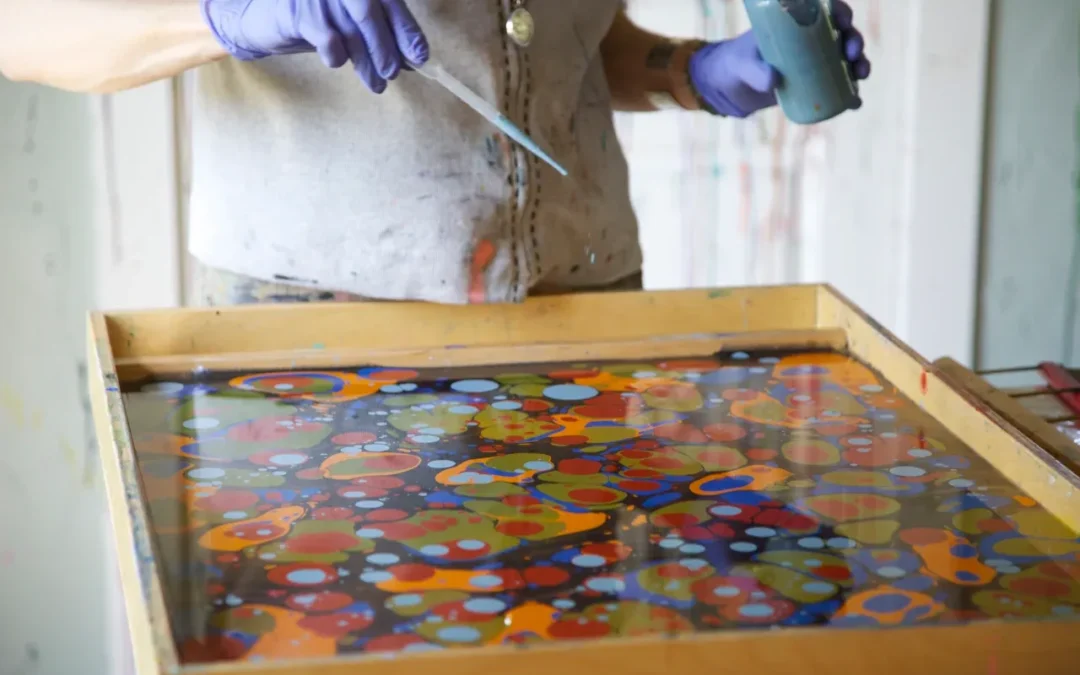
Paper marbling is the art of floating color on the surface of a liquid, shaping it into a pattern, and then transferring that pattern onto paper. The color never soaks into the liquid. It rests on top, where you can move the color simply by blowing on it, or by using a stylus or comb, before the paper lifts it away.
That controlled movement is what gives marbled paper its signature look: fine veins, rippling bands, feathered curves, and layers of color that seem to flow into one another.
Marbled vs. Printed Paper
Hand-marbled paper is made one sheet at a time, directly from the floating color. Printed marbling reproduces the look of a marbled sheet with ink, digitally or mechanically. Both have their place, and good printed papers can be beautiful.
The difference is repetition. As the University of Washington Libraries’ Historical Book Arts Collection explains, printed papers are the one form of decorated paper that produces identical sheets; hand processes like marbling produce unique ones.
Handmade Variation
No two hand-marbled sheets match, even when the same maker uses the exact colors and tools on the same day. Small changes add up like:
- how much color is dropped, and where.
- how quickly the pattern is shaped.
- the order in which colors are added.
- the moment and angle at which the paper meets the surface.
This is why marbled paper is prized. Each sheet records a single moment that can’t be repeated.
How Paper Marbling Is Made
Every marbling method shares three basic stages, though materials and preparation vary by tradition. Some methods float color on plain water, while others use a thickened bath called “size,” which slows the color down and allows more detailed patterns.
Preparing the Surface
The marbler prepares a shallow tray of water or size and mixes colors that will float rather than sink. In some methods, the paper is treated first. The University of Washington Libraries describes coating one side of the paper with alum, which helps the color hold, and making the size by blending carrageenan, a seaweed-derived thickener, with water.
Shaping the Pattern
The marbler drops, sprinkles, or brushes color onto the surface, where it spreads into rings and pools, then shapes it in one of the following ways.
- Breath or a fan pushes color into soft, drifting currents
- A stylus draws lines through the color
- Combs and rakes pull color into repeating bands, feathers, and scallops
Most traditional patterns use several colors, layered one after another.
Pulling the Print
The paper is laid gently onto the surface so it picks up the floating color in one pass. The marbler lifts it away, rinses off excess color if the method requires it, and hangs or lays the sheet flat to dry. Once the print is pulled, that pattern is gone from the tray forever.
Types of Paper Marbling
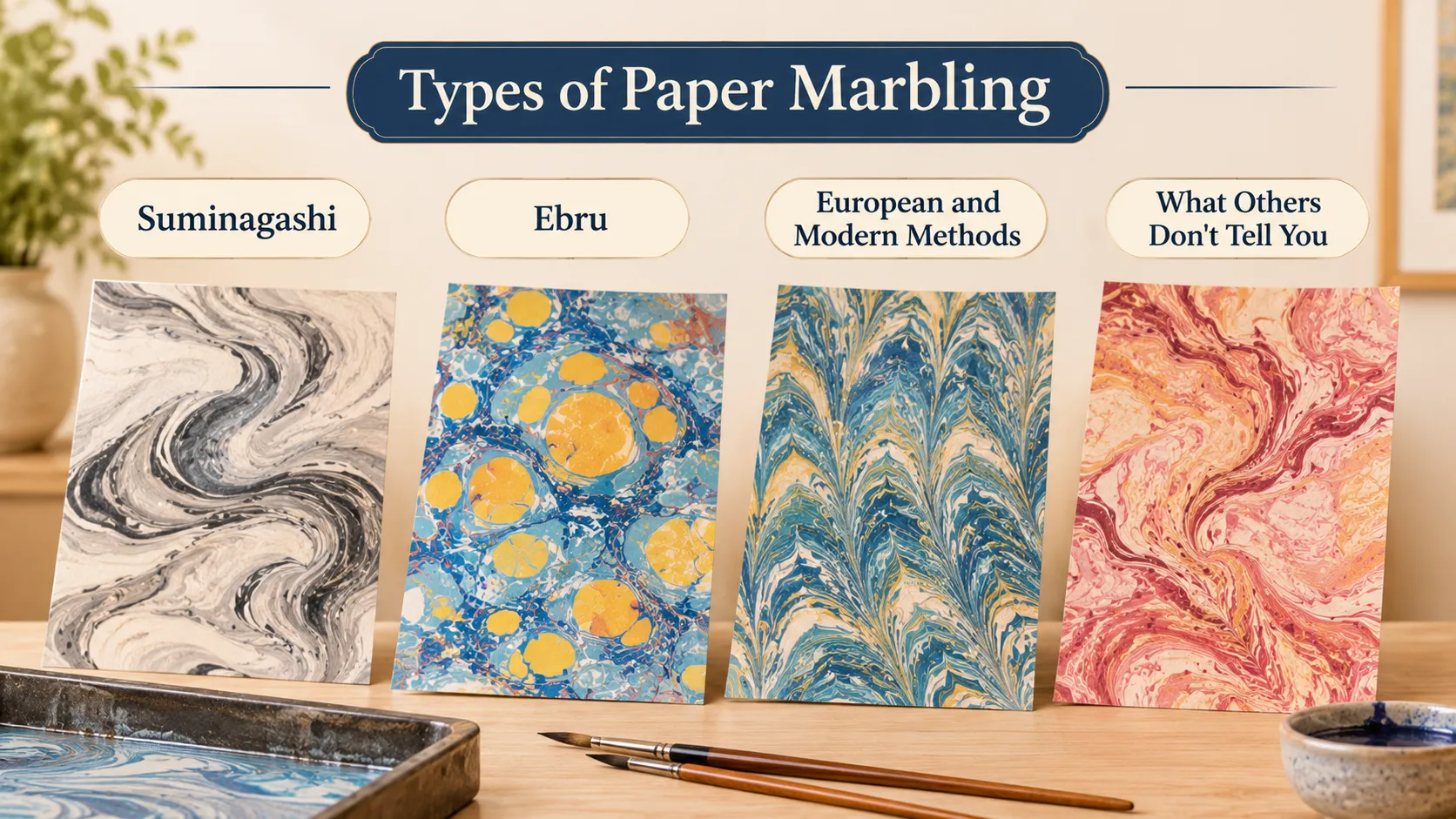
Marbling developed in different places, using different materials and serving different goals. The history is genuinely unsettled in places, so the traditions below are best understood as related crafts, not one art with a single starting point.
Suminagashi
Suminagashi, meaning “ink floating,” is the Japanese tradition and is generally considered the oldest form. According to the University of Washington Libraries, it dates to the 12th century, with sumi ink dropped on water and blown into patterns with a hand fan before being picked up on paper.
The results are delicate, concentric rings and loose, flowing currents, often in black or soft blue. Suminagashi uses plain water rather than a thickened size, which is why its patterns look so fluid.
Ebru
Ebru is the Turkish tradition, and the one most closely linked to later European marbling. The University of Washington Libraries notes that the earliest documented sheet of marbled paper in the Near East comes from Turkey and dates to 1447.
UNESCO, which inscribed ebru on its Representative List of the Intangible Cultural Heritage of Humanity in 2014, describes artists mixing natural pigments with a few drops of ox gall, then sprinkling and brushing them onto a thickened liquid. Ebru designs can include flowers, foliage, and lattice patterns, and UNESCO notes that reaching basic skill takes at least two years of training with a master.
European and Modern Methods
Turkish marbled papers traveled west, and European marblers developed their own bookbinding patterns. The University of Washington Libraries says European marbling seems to have flourished first in Italy as early as the 16th century.
European marblers guarded their methods closely. According to UCD Special Collections, that secrecy lasted until Charles Woolnough published his methods, and industrial bookbinding later contributed to the marbling trade’s decline.
Today, the craft lives on in studios, workshops, and classrooms. The American Institute of Physics’ Niels Bohr Library & Archives points out that marbling now spans everything from centuries-old book decoration to shaving-cream versions made at a picnic table.
What Others Don’t Tell You
Marbling is not as secure as its long history suggests. The City & Guilds of London Art School reports that paper marbling appears as an endangered craft on the 2023 Red List of Endangered Crafts from the UK charity Heritage Crafts. Buying hand-marbled work or taking a class is one of the most direct ways to keep the skill alive.
How Marbled Paper Is Used
For most of its history, marbled paper belonged to books. The Niels Bohr Library & Archives notes it was most often used for endpapers but also for full covers and even marbled book edges. It has also been used on:
- stationery, journals, and notebook covers.
- boxes and box linings.
- framing, mats, and wall art.
- decorative accessories for the home.
Marbling isn’t limited to paper, either. At Shandell’s, Susan Schneider hand-marbles vegetable-tanned leather for her marble journal covers, and decoupages marbled paper onto each marble tissue box cover in her Massachusetts studio, so no two pieces look alike.
Lampshades show marbled paper at its most dramatic. Unlit, a marbled shade appears as a pattern of color. When switched on, light passes through the sheet, and the veining glows. Scale matters too: a sheet only covers so much, and on Shandell’s larger shades, two marbled sheets are needed, so a seam runs at the back. That honesty about how the paper behaves is part of what makes each shade unique. For help pairing a patterned shade with a base, see our guide on how to choose lampshade size.
Paper Marbling FAQs
Is Paper Marbling the Same as Ebru?
Not exactly. Paper marbling is the broad category. Ebru is a specific Turkish tradition within it, known for pigments floated on a thickened liquid and designs that can include flowers and foliage.
Can Any Paper Be Used for Marbling?
Not every paper works well for marbling. Absorbency, strength, surface treatment, and how the paper reacts with the chosen colors all affect the result. Some methods also require pre-treating the paper, such as with alum.
What Can Marbled Paper Be Used For?
Marbled paper is used for book covers and endpapers, stationery, gift wrap, framing, boxes, and home décor. It's also used on lampshades, where light passing through the paper brings the pattern to life.