
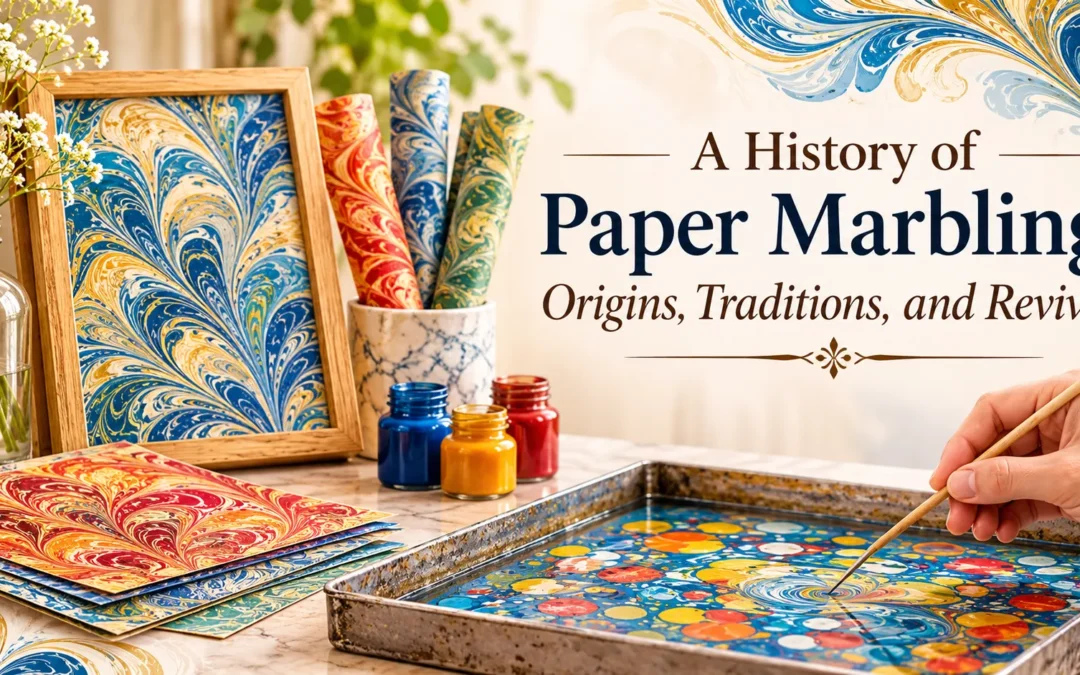
Marbling has traveled far historically, but kept its secrets for a remarkably long time. The history of paper marbling runs from poetry anthologies in medieval Japan, through the calligraphy albums of Iran and the Ottoman world, into the workshops of European bookbinders, and finally into the studios of artists still making it by hand today.
This guide follows that path, separating what surviving objects can tell us from the legends that have grown up around the craft.
What Paper Marbling Is: A Transfer-Print Process
Marbling is a transfer process. Colors float on the surface of water or a prepared liquid, are shaped into a pattern, and then lifted onto a sheet of absorbent paper laid on top. Each pull takes the pattern with it, so every sheet is a single, unrepeatable print.
A quick note on terms:
- Marbled paper is the formal name for paper decorated this way.
- Marble paper is a common informal name, used in many shops and product names. It has nothing to do with stone; as early as 1627, Francis Bacon described Turkish marbled paper as veined like marble.
- Printed marble patterns imitate the look with ink and can be reproduced identically. True marbling can’t.
Origins of Paper Marbling in Asia and the Ottoman World
Marbling has more than one early lineage. Japan and the Persian-Ottoman world both developed distinct traditions, and historians don’t agree on a single, proven route connecting them. The safest way to tell the story is tradition by tradition.
| Period | Place | What the evidence shows |
|---|---|---|
| Early 12th century | Japan | The earliest surviving suminagashi, in a Kyoto temple anthology |
| Late 15th century onward | Iran and Ottoman Turkey | Marbled papers in manuscripts and calligraphy albums |
| 1447 | Turkey | Earliest documented marbled sheet in the Near East |
| Early 17th century | Europe | Marbling workshops begin to appear. |
| 1853 | Britain | Woolnough publishes an unusually detailed marbling manual. |
Suminagashi in Japan
Suminagashi, or “floating ink,” is the oldest marbling tradition with surviving examples. According to the Japanese Architecture and Art Net Users System (JAANUS), hosted by Columbia University, the earliest known suminagashi appears in an early 12th-century poetry anthology held at Nishi Honganji temple in Kyoto.
The method is simple and delicate. A few drops of ink are floated on water; the ink drifts into flowing lines, and a sheet of paper is laid on top to capture the wave-like pattern. JAANUS notes that indigo and safflower dyes were used alongside black ink, and that the technique was applied to cloth as well as paper.
Suminagashi belonged to the world of poetry and calligraphy, where decorated papers framed elegant handwriting. A popular story credits its discovery to a member of the imperial family who noticed ink floating on water. It’s a charming tale, but it’s best treated as legend rather than fact.
Persian and Ottoman Traditions
The tradition most closely tied to later European marbling grew up in Iran and Ottoman Turkey. The Metropolitan Museum of Art explains that the Turkish name, ebru, and the Persian name, abri, both relate to the word for “cloud.” Ebru was especially favored for calligraphic work.
In Ottoman ebru, as UNESCO describes it, pigments are floated on a thickened liquid, which allows far more control than water alone. Artists used marbled papers to frame calligraphy and decorate manuscript margins; the Met highlights a manuscript whose margins were embellished by Safavid artists with marbled paper and sprinkled gold. Ebru masters also held a respected place among artists and artisans.
When exactly this tradition began is harder to pin down. The University of Washington Libraries dates the earliest documented marbled sheet in the Near East to 1447, from Turkey. A Met exhibition of decorated papers, Clouds and Gold Dust, traced marbling and related paper-decorating techniques from Central Asia across Iran and into Turkey.
How Paper Marbling Entered European Book Arts
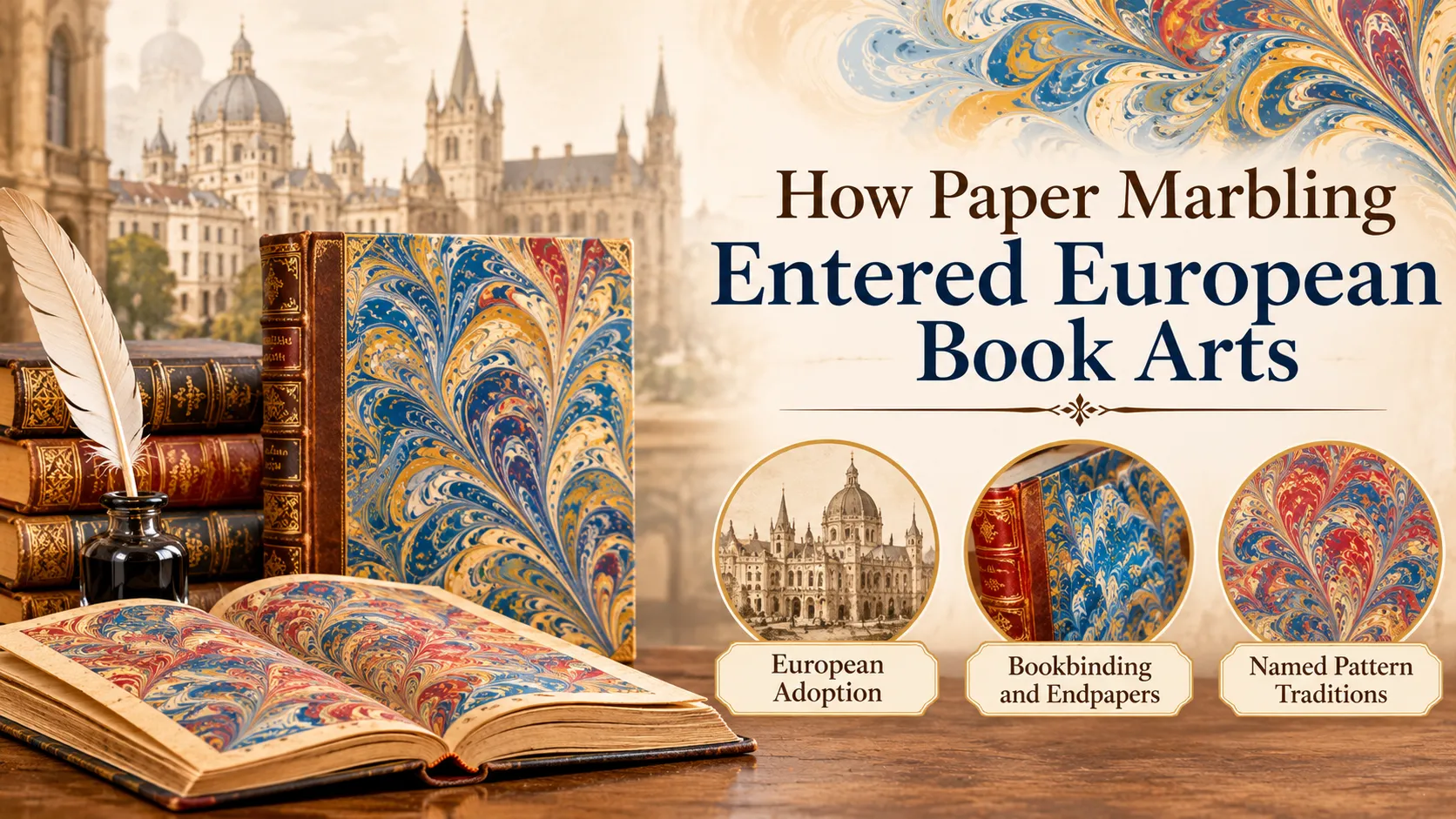
Europeans first met marbling as an import. Travelers described it, collectors brought marbled papers home, and craftspeople eventually worked out how to make it themselves.
European Adoption
Written accounts show this curiosity. The V&A’s National Art Library notes that Francis Bacon described the Turkish art in 1627, before marbling was popular in England. Among the library’s earliest examples is a friendship album gathered and bound in Turkey in the early 17th century, when European marbling workshops were just beginning to open.
Accounts differ on where European production began. The V&A suggests the first European marbled papers were probably made in early 17th-century Germany. At the same time, the University of Washington Libraries says marbling seems to have flourished first in Italy as early as the 16th century. Both agree the craft spread across Europe from there.
Marblers guarded their methods closely. The V&A describes tales of masters working in sealed rooms to keep out spies. In 1853, Charles Woolnough published a manual detailed enough to set out the popular patterns of his day, and his preface records the hostility of marblers who felt their secrets had been exposed.
Bookbinding and Endpapers
Bookbinders made marbled paper part of the book itself. It was used for:
- Endpapers, the decorated sheets inside the covers
- Covers, where marbled paper decorated the boards
- Book edges, which many binders marbled and polished as well
The V&A credits the French with establishing the close link between marbling and bookbinding. Britain was slower: it imported marbled paper from France and Germany until local production caught up in roughly the 1770s and 1780s. Today, library collections hold countless examples, which is why so many of us picture marbled endpapers when we think of antique books.
Named Pattern Traditions
As workshops grew, patterns gained names and regional identities. The V&A’s collection includes examples such as:
- Combed patterns, including one sometimes called “Dutch,” seen in a book from Paris, 1730
- Snail patterns, swirled into spirals, in a Paris book from 1764
- Spanish wave, a rippling pattern in a London book from 1828
- Nonpareil, a pattern that became ubiquitous in the Victorian era
Tools, pigments, the liquid bath, and local taste all shaped these styles. The V&A also notes that the process involved ox gall mixed into the paint.
Paper Marbling in the Modern Era
Mechanization and Revival
The 19th century brought both the trade’s peak and its decline. According to the V&A, marbling machines and purpose-made paints increased output, but mechanized book production soon favored cheaper cloth bindings with little decoration. By the early 20th century, the remaining bookbinders mainly used marbled paper.
The craft survived through small workshops and individual artists who kept experimenting. That survival still needs support: the City & Guilds of London Art School reports that paper marbling is listed as endangered on the 2023 edition of the UK Heritage Crafts Red List. Teaching workshops, artisan studios, and conservation work all help keep the knowledge alive.
What Others Don’t Tell You
Marbled paper on lampshades isn’t a modern novelty. The V&A holds a portfolio of marbled papers from 1930 to 1932 by the English firm Douglas Cockrell & Son, produced for book sides and endpapers, lampshades, and wallpaper. Long before that, the V&A notes that 17th-century marbled paper was used to line boxes and decorate furniture. Marbling has always lived beyond the book.
Contemporary Decorative Arts
Today, marbled paper appears in stationery, boxes, framed artwork, and home décor. Lampshades suit it especially well, as light passing through the sheet makes the pattern more vivid.
That’s the tradition Shandell continues. Susan Schneider makes paper lampshades and smaller pieces such as marble paper nightlights, trimmed in grosgrain, and each marbled pattern is unique. For anyone who wants to try the craft, Susan also teaches a paper marbling workshop for beginners, with all supplies provided.
Frequently Asked Questions About Paper Marbling
What Is the Difference Between Suminagashi and Ebru?
Suminagashi is the Japanese tradition of floating ink on plain water to produce soft, wave-like patterns. Ebru is the Turkish tradition of floating pigments on a thickened liquid, which allows more controlled, detailed designs.
Why Was Marbled Paper Used in Old Books?
Bookbinders used marbled paper to decorate endpapers, covers, and page edges. It was attractive, and the patterns became closely associated with fine binding, especially in France and Britain.
Is Paper Marbling Still Done by Hand Today?
Yes. Bookbinders, paper artists, conservators, and decorative studios still marble by hand, though the craft is now considered endangered in the UK. Workshops and artisan makers help keep it alive.