
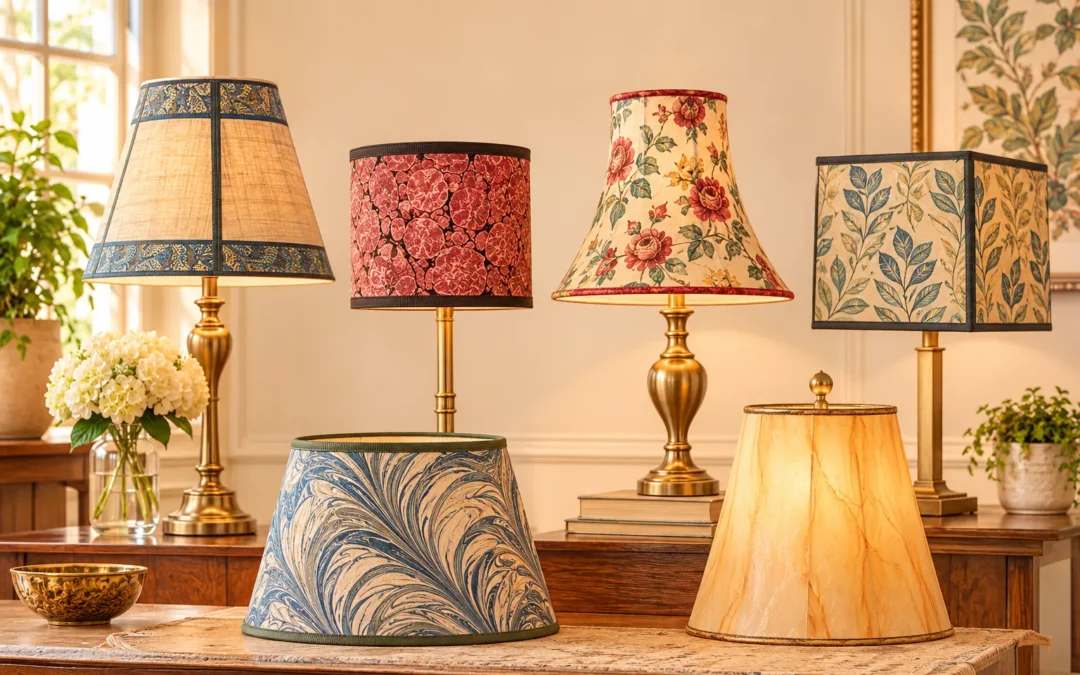
A shade’s silhouette does two jobs at once: decides where the light goes, and how the whole lamp looks, lit or unlit. Swap a drum shape for an empire on the same base, and you can change a lamp from crisp and modern to soft and classic in seconds.
This lampshade shape guide covers the different lampshade shapes and their names, how each one handles light, how to pair a shape with a base, and how to finish the decision with the right material and pattern.
Types of Lampshade Shapes and Their Names
The easiest way to understand types of lampshade shapes is to sort them by geometry: straight sides, tapered sides, curved sides, and non-round footprints. Most lampshade shape names fall into one of these families.
One clarification before the list: pleats, fabrics, trims, and fitters are construction and finishing details, not shapes. A pleated empire is still an empire shape. Names also vary between makers, so one shop may call a “tapered drum” an “empire” in another. Dimensions tell you more than labels.
| Shape family | Profile | How light tends to leave | Often suits |
|---|---|---|---|
| Drum and cylinder | Straight, vertical sides | Evenly through top and bottom | Simple, slender, or modern bases |
| Empire and cone | Narrow top, wider bottom | More light directed downward | Rounded, traditional or reading lamps |
| Bell, dome, and pagoda | Curved or sculpted sides | Varies with the curve and openings | Ornate or characterful bases |
| Oval, square, and rectangle | Non-round footprint | Similar to round shades of the same taper | Angular bases, narrow tables |
Drum and Cylinder
Drum shades have equal or nearly equal top and bottom diameters, giving them straight, vertical sides. A cylinder is a taller, narrower version of the same idea.
Because the sides don’t slope, a drum offers a broad, flat surface that shows decorative patterns clearly and without distortion. That makes it a natural choice for bold prints and hand-marbled papers.
Empire and Cone
Both shapes taper from a narrow top to a wider bottom. The difference is the angle:
- Empire: a moderate taper, the classic silhouette on many table lamps
- Cone: a much steeper taper, with a small top and a very wide rim
The steeper the slope, the more visual weight sits at the bottom. A cone shade can feel dramatic and grounded; an empire feels balanced and familiar.
Bell, Dome, and Pagoda
These shapes use curves rather than straight lines:
- Bell: sides that curve outward toward the bottom rim
- Dome: a rounded, bowl-like profile
- Pagoda: a flared bottom edge that sweeps outward, often with a tiered or concave curve
Curved shades are often linked to traditional rooms, but they don’t have to stay there. A plain bell on a sleek, modern base can look fresh precisely because of the contrast.
The more sculptural the shape, the more attention it draws. The University of Minnesota bulletin cautions that pagoda shades can easily dominate an average room, so they work best where the shade is meant to be the focal point.
Oval, Square, and Rectangle
Non-round shades bring geometry that echoes angular bases and architectural rooms. An oval shade is slimmer front to back, so it can work well on narrow consoles and tables pushed against a wall. Square and rectangular shades suit bases with straight edges and rooms with strong lines. Shandell’s makes rectangular shades alongside round ones, as well as half lampshades with a flat back.
How Lampshade Shape Affects Light and Style
Shape matters, but it is only one part of the picture. Material, lining, opacity, and the bulb you choose all change how a lamp performs.
Light Distribution
In general, the size of each opening affects where light can go:
- Drum shades let light out through two openings of similar size, so light travels both up and down
- Empire and cone shades have a small top and a wide bottom, so more light falls downward
- Open or shallow profiles let more light escape to the sides
Lining and material can shift these patterns significantly. A University of Minnesota Extension bulletin on home lighting advises giving dark-covered shades a white or very light lining, noting that white reflects about 85% of light. The same bulletin recommends a top opening wide enough to send roughly a third of the light upward for general room lighting. A translucent material like hand-marbled paper lets light glow through the sides, too.
Visual Weight
Shape also controls how heavy or light a lamp feels, especially on table lamps, where the shade sits close to eye level:
- A broad lower rim grounds the lamp
- Vertical sides make it feel streamlined and taller
- Curved profiles add a sculptural, decorative quality
How to Choose a Lampshade Shape for a Lamp Base
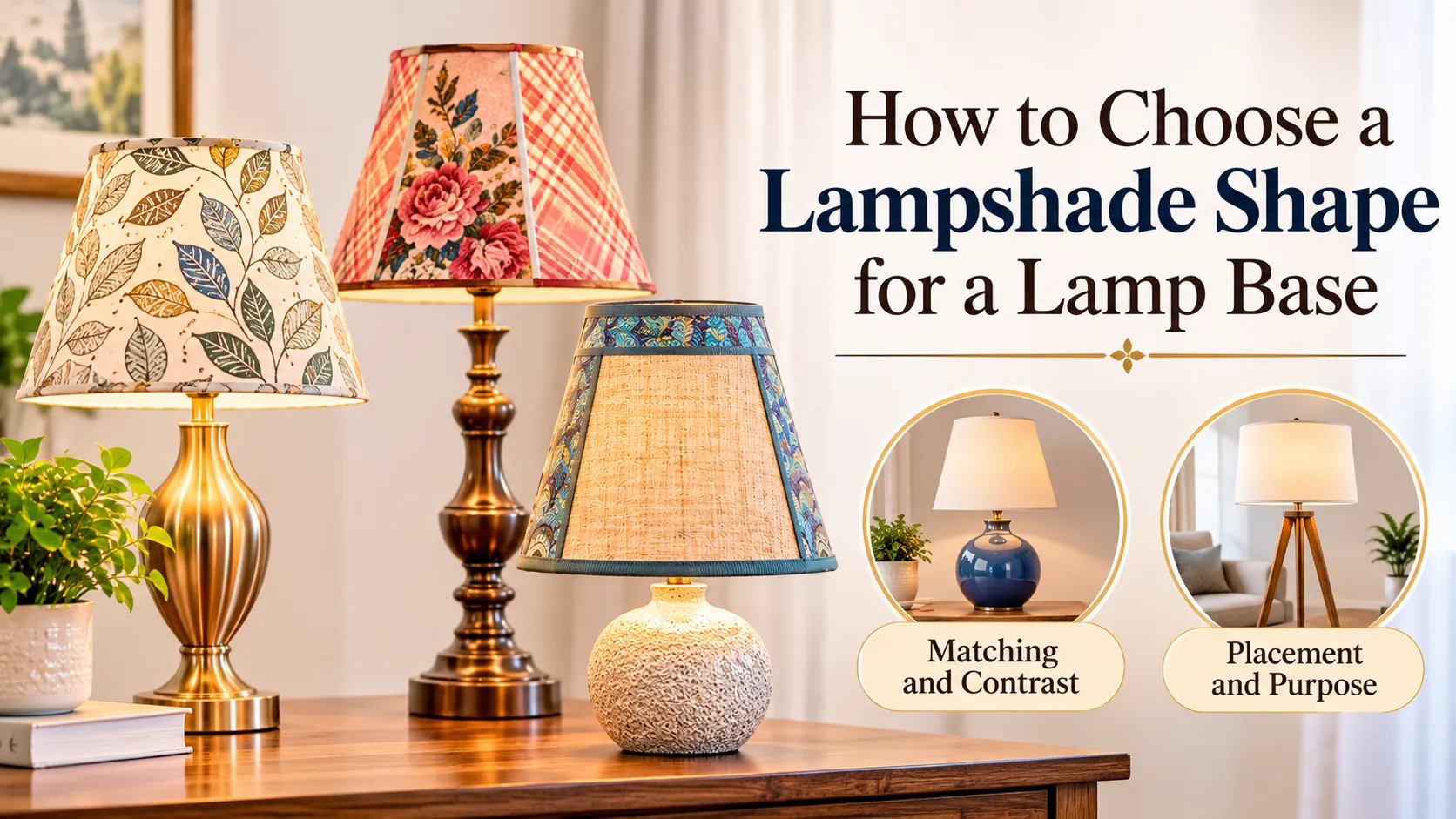
Matching and contrasting are both valid approaches. What matters is that the finished lamp feels balanced and suits where it sits and what it needs to do.
Matching and Contrast
Echoing a base’s lines is the safest route: round with round, angular with angular. The University of Minnesota bulletin pairs round and columnar bases with round, oval, or conical shades and saves square and rectangular shades for bases with straight lines. An empire shade on a rounded ceramic base is a classic example, because the gentle taper repeats the curve of the body.
Contrast takes more care but can be striking. A patterned drum on a slender, architectural base works because the straight sides keep the silhouette clean while the pattern adds interest. The key is scale. A contrasting shape should never make the lamp look top-heavy.
Placement and Purpose
Think about the job before the look:
- Bedside table lamps: a tapered shade helps direct light down toward a book while keeping glare away from your eyes when lying down
- Reading table lamps by a chair: a shape that covers the bulb from a seated sightline matters more than style
- Console table lamps: an oval or narrower shade avoids overhanging a slim surface
- Accent table lamps: decorative shapes and patterns can take the lead, since these lamps are about atmosphere rather than task light
How to Measure for the Right Lampshade Shape
Measurements help you size a shade and identify its shape. Record four dimensions:
- Top diameter
- Bottom diameter
- Height
- Slant, the length along the side, which is longer than the height on tapered shades
Equal top and bottom diameters point to a drum. A small top and wide bottom point to an empire or cone, depending on how steep the slant is.
Proportion and Dimensions
Use proportion guidelines as starting points, not fixed rules. Many guides suggest a shade about two-thirds the height of the base, with a bottom diameter close to the base’s height. Experts vary, though. In an Ideal Home feature, one lighting designer suggests a shade roughly 1.5 to 2 times the width of the base and about 40% of the total lamp height. In contrast, an interior designer notes the right answer depends heavily on the base itself.
Fitters and Hardware
Shape and size mean nothing if the shade can’t attach safely:
- Spider fitters sit on a harp and are held by a finial
- UNO fitters sit directly on the socket
- Clip-on fitters attach to the bulb, usually on small chandelier and sconce shades
Check that your harp, finial, socket, and bulb all match the shade’s fitter. Follow the bulb limits marked on the lamp, too; in a safety release with the National Electrical Safety Foundation, the U.S. Consumer Product Safety Commission advises against replacing bulbs with a higher wattage than recommended to prevent overheating.
How to Finalize Shape, Material, and Pattern
To finalize the shape, material, and pattern of the lampshade you want, decide in this order:
- Physical fit: fitter, harp, and bulb compatibility
- Proportion: height and width against the base
- Light needs: task, ambient, or accent
- Silhouette: matching or contrasting shape
- Decorative finish: material, color, and pattern
What Others Don’t Tell You
Shape changes how a pattern looks. A drum shade is made from a flat rectangle wrapped into a tube, so a pattern stays upright and even all the way around. A straight-sided tapered shade, like an empire or cone, is cut from a curved, arc-shaped piece, so the pattern tilts and compresses toward the top. On a bold marbled paper, that can add movement; on a strict stripe, it can look off.
Sheet size matters too. A single marbled sheet only covers so much, and some of Shandell’s larger shades need two sheets, which means a seam at the back. It’s worth knowing before you place a lamp where the back will show.
This is where a clean shape earns its place. At Shandell’s, Susan Schneider makes lampshades from marbled paper, grass cloth, fabric, vintage wallpaper, and silk, and each marbled pattern is unique. Simple silhouettes let those materials shine without competing. If no standard shape fits your lamp, a custom lampshade can be sized and shaped around it.
The right choice should look intentional twice: once switched off, as an object in the room, and again lit, as a light source.
Frequently Asked Questions About Lampshade Shapes
Should a Lampshade Match the Shape of the Lamp Base?
Matching shapes is the easiest way to get a balanced look, but contrast can work beautifully when the scale stays in proportion, and the shade doesn't make the lamp look top-heavy.
What Is a Spider Lampshade?
A spider lampshade has a spider fitter, a wire frame at the top that rests on the lamp's harp and is secured with a finial. It's one of the most common types of fitter for table lamps.
How Do You Measure a Lampshade?
To determine a lampshade’s size, measure the top diameter, bottom diameter, height, and slant along the side. Note the fitter type, too. Together, these tell you the shade's shape and whether it will suit your base.